 how-to
How to Choose a Wedding Photo Booth: 2026 Guide
Table of Contents
- Start With the Guest Experience You Want
- Wedding Photo Booth Types and Which Fits Your Reception
- Match the Booth to Your Venue Space and Guest Capacity
- Wedding Photo Booth Duration: How Long to Book
- Prints, Templates, and Digital Photo Booth Sharing
- Wedding Photo Booth Rental Questions to Ask Before Booking
- A Practical Decision Framework for Couples
- What Matters Most
- Frequently Asked Questions
Last Updated: October 21, 2026
Start With the Guest Experience You Want
The best way to choose a wedding photo booth is to decide, before comparing vendors, what you want guests to feel when they walk up to it.
This guide covers booth formats, venue fit, timing, and the contract questions that separate a smooth rental from a stressful one.
Most couples start with price. A more useful starting point is the moment itself: a formal portrait station for a black-tie reception, or a loud corner where the dance floor spills over between songs?
Three priorities drive the rest of the decision:
- The photo you keep: a crisp print, a digital file, or both
- The crowd you expect: a 60-guest dinner behaves nothing like a 250-guest party
- The room you have: floor space, ceiling height, and power access all constrain format
Wedding Photo Booth Types and Which Fits Your Reception
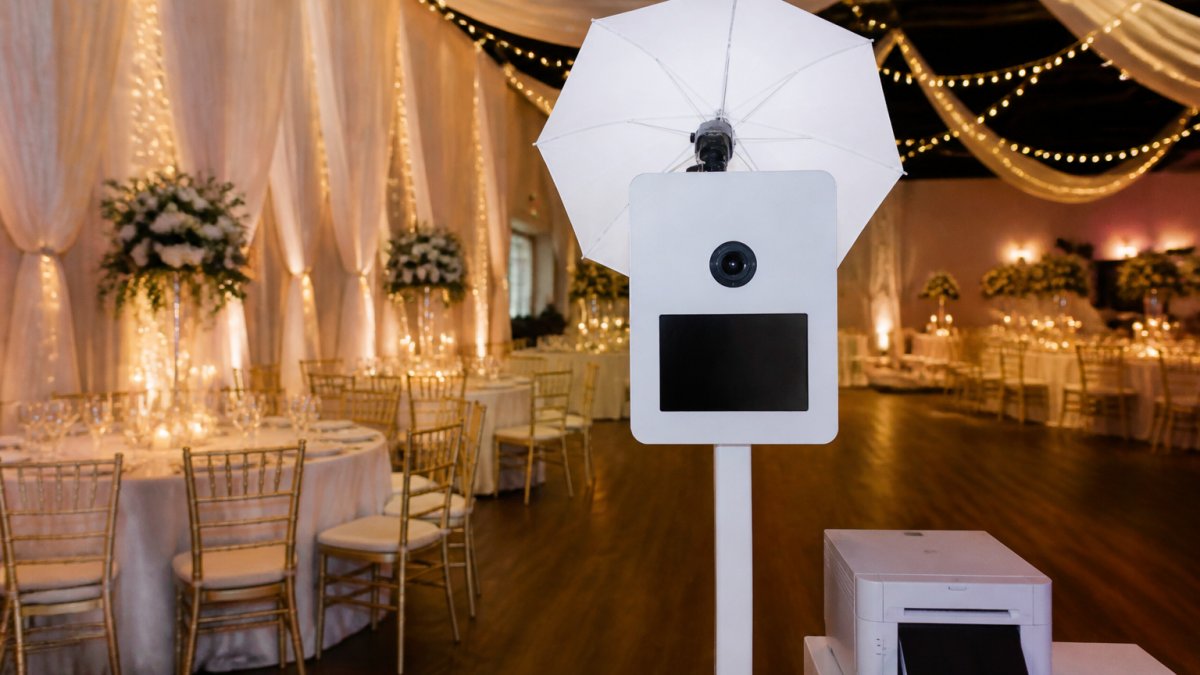
Booth formats split into two families: open-air and enclosed. Open-air designs use a freestanding backdrop and camera rig with no walls, so larger groups can gather and passersby see the fun.
The right format depends on your guest list and your reception's energy. A seated dinner with 70 guests suits an enclosed booth that produces intimate portraits.
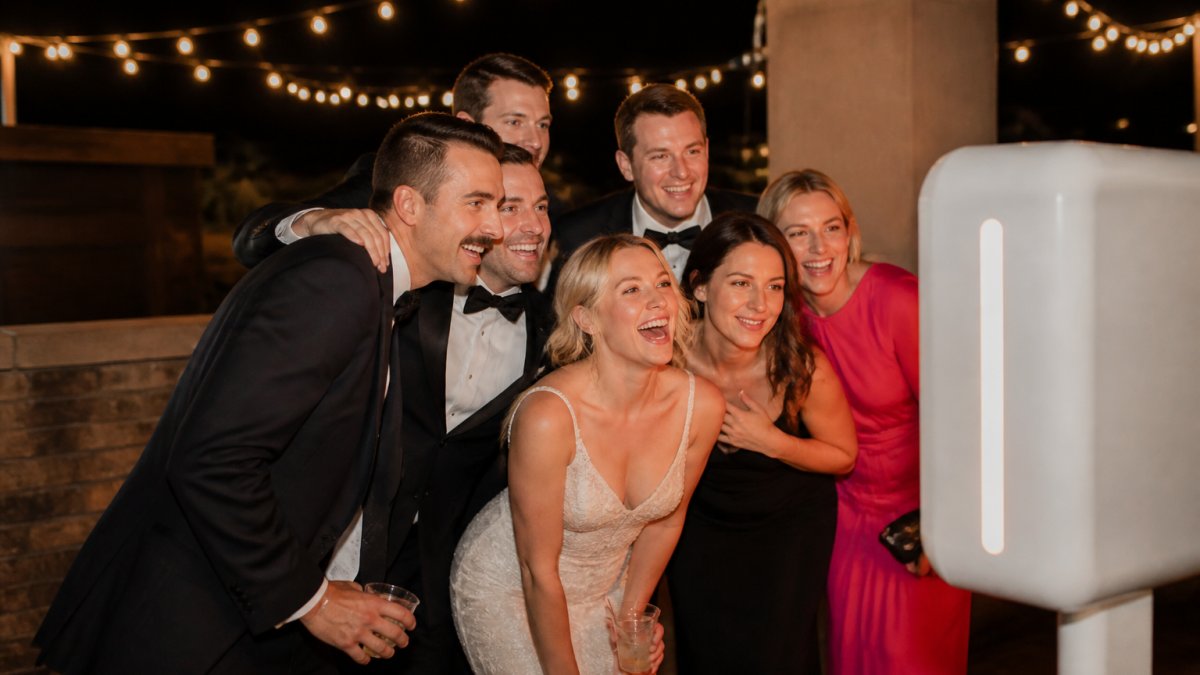
Open-Air Versus Enclosed Booths
Open-air booths win on group size and visibility, and let a vendor frame the venue's best features. The trade-off is ambient light, candles, uplighting, a DJ's moving beams, landing on faces, which vendors offset with key and fill lights on stands.
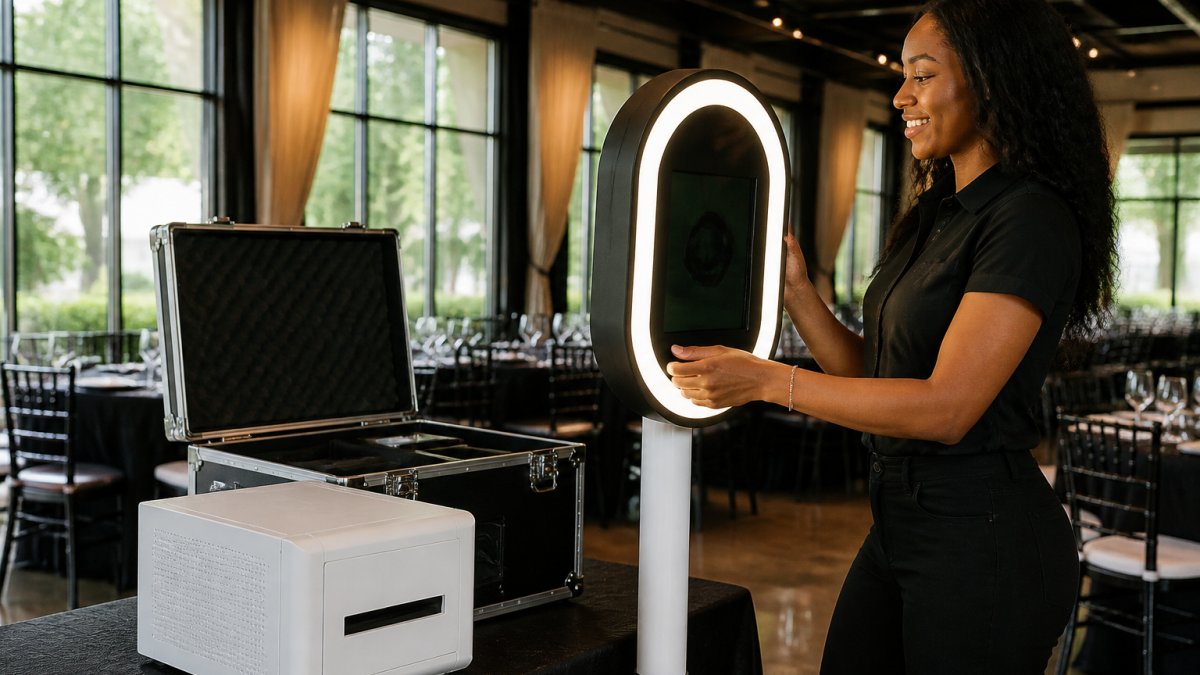
Enclosed booths win on intimacy and consistency: the curtain controls the light, so image quality stays steady regardless of the room.
Throughput matters as much as capacity. A single station serves roughly 40 to 60 guests per hour when a session runs two to three minutes including print time.
| Format | Best For | Typical Group Size | Space Needed | Lighting Control |
|---|---|---|---|---|
| Open-air booth | High-energy parties, large guest lists | 8-10 adults | Larger footprint; room for light stands | Relies on dedicated key and fill lights |
| Enclosed booth | Formal dinners, intimate portraits | 4-6 adults | Compact footprint | Curtain controls ambient light |
| Selfie station | Tight venues, casual celebrations | 1-4 guests | Minimal; tabletop or tripod | Depends on room light; ring light helps |
| GIF booth | Younger crowds, social sharing | 4-8 guests | Moderate | Similar to open-air |
Digital, GIF, and Selfie Station Formats
Digital-only setups skip printing and send images by text or email, suiting couples who want a paperless experience and a full gallery afterward. Without a printer, sessions often run under a minute, raising throughput and shortening lines.
GIF formats capture a short looped animation instead of a still. They draw repeat visits, especially from younger guests, and the shareable file travels well on social platforms.
Selfie stations are the lightest option: a ring light, a phone or tablet, and a branded frame.
Accessibility and Inclusive Guest Experience
Format choice should account for every guest, not just the average one. Ask these questions before committing:
- Entry and floor level: Does the booth have a level entry or a low ramp? A raised platform or a step up excludes guests using wheelchairs or walkers, and it trips guests in heels.
- Seated posing: Can a guest remain seated and still be framed well? An open-air rig with an adjustable camera height handles this better than a fixed-height enclosed stall.
- Lighting sensitivity: Flashing strobes can be uncomfortable for guests with light sensitivity or sensory needs. Ask whether the vendor can run continuous lighting instead of a strobe, and whether the flash can be softened.
- Language and instructions: On-screen prompts and printed instructions should be simple and legible. Ask whether the vendor can display instructions in more than one language if your guest list calls for it.
- Attendant assistance: A trained attendant who offers to help without being asked makes the difference for older guests and anyone unfamiliar with the interface.
An inclusive guest experience is a design choice, not an afterthought. Vendors who plan for it answer these questions without hesitation.
Match the Booth to Your Venue Space and Guest Capacity
Floor space and guest count decide more rentals than any other factor. A common mistake is booking a booth that fits the room but not the crowd: if 200 guests want a turn in a two-hour window, the line becomes the experience.
Walk your venue with three numbers in mind: the clear floor area the vendor needs, the distance to the nearest power outlet, and the path guests will take to reach the booth. A good vendor will ask for a floor plan before confirming.
Venue Logistics and Contingency Planning
Most booth problems at weddings are logistics problems, not equipment problems.
Power. Confirm the outlet location, distance to the booth, and circuit load.
Connectivity. Digital sharing depends on a signal.
Weather protection. For outdoor or tented setups, confirm the vendor provides a canopy, weighted bases, and a plan for wind and rain.
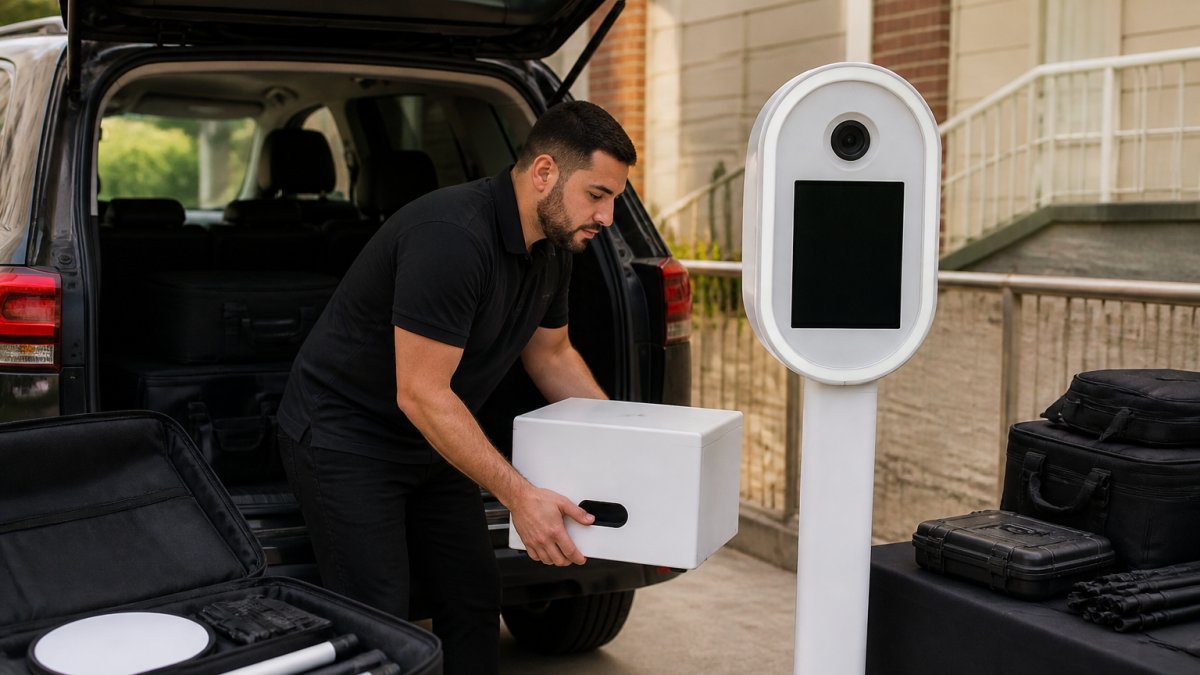
Setup and breakdown time. A booth that needs 90 minutes to build should not open the same minute cocktail hour begins.
Backup plan. Ask what the vendor does if a camera, printer, or light fails mid-reception.
Guest Capacity and Throughput
Capacity is not the same as throughput. A booth that holds ten people but takes four minutes per session serves fewer guests per hour than one that holds six and takes ninety seconds.
For 150 or more, plan for a booth that handles groups of six to ten and consider a second station or a longer window. Under 80 guests, a single enclosed booth rarely backs up. In a tight venue, a selfie station or compact enclosed booth preserves floor space.
Wedding Photo Booth Duration: How Long to Book
Most wedding receptions book a booth for three to four hours, opening after dinner and closing near the end of the night, when guests are relaxed, the dance floor is full, and people are willing to be silly.
Wedding photo booth duration should follow your timeline, not a package tier. If your reception runs five hours with a plated dinner, a booth opening at cocktail hour sits idle for ninety minutes.
Build the window around three moments: cocktail hour, the post-dinner energy peak, and the final hour. Then decide whether you want coverage across all three or just the middle.
- Cocktail hour add-on: captures guests in formal attire before the party loosens up
- Post-dinner core block: the standard three-hour window most couples choose
- Final-hour extension: catches the late-night crowd and the best candid expressions
Prints, Templates, and Digital Photo Booth Sharing
Print versus digital is not either-or. Most modern rentals deliver both: instant prints at the booth and a digital gallery afterward.
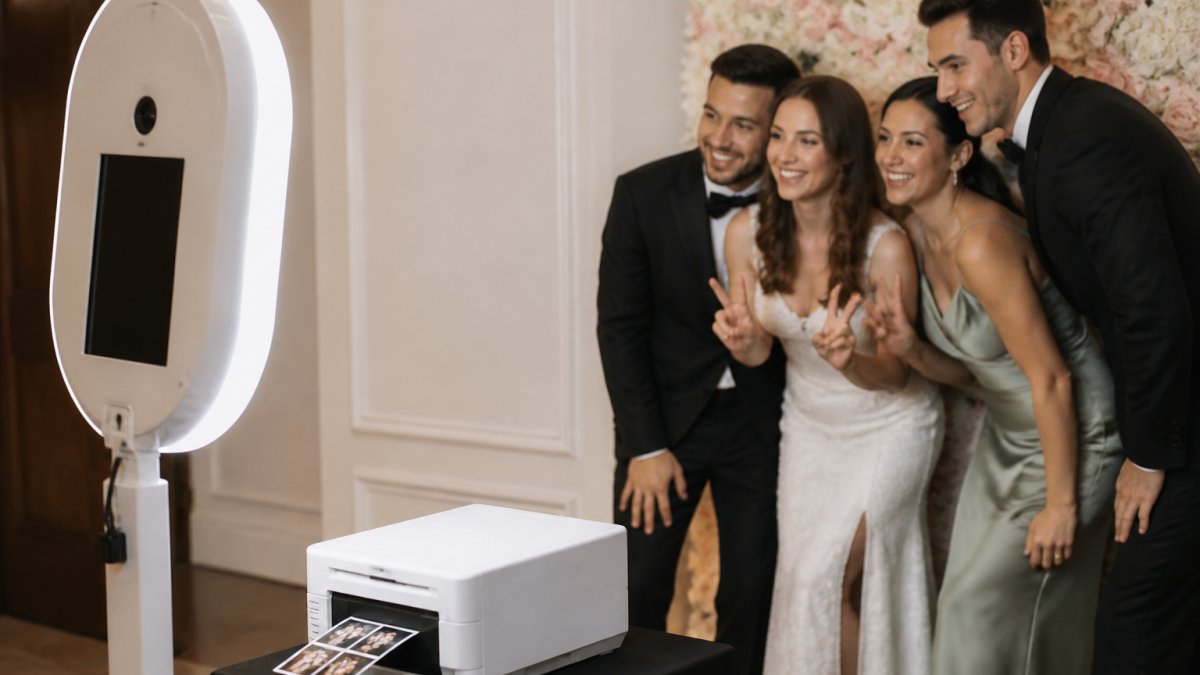
Photo strips remain the keepsake of choice for weddings, guests tuck them into purses and take them home. Custom templates frame each strip with your names, date, and a design that matches your invitation suite, and prints double as favors.
Digital photo booth sharing covers guests who want a copy on their phone within seconds, via text, email, QR codes, or a shared online gallery. A gallery also gives you a full archive after the wedding.
Wedding Photo Booth Rental Questions to Ask Before Booking
The questions below separate a professional vendor from a hobbyist. Ask them before signing.
- What is the exact footprint, and does it fit my floor plan?
- How many hours are included, and what does an extra hour cost?
- Is an attendant on site for the full rental, or only during setup?
- What is the backup plan if a camera, printer, or light fails mid-reception?
- How and when do guests receive digital copies?
- Can we approve a custom template before the event?
- What is the deposit, cancellation policy, and liability coverage?
- How is guest data handled, and who owns the photos?
That last pair matters more than couples expect. Contract and privacy details are where disputes originate. Confirm in writing who owns the images, how long the gallery stays live, and whether the vendor may use your event photos in marketing.
A Practical Decision Framework for Couples
Use this framework to move from priorities to a shortlist. Score each vendor against your top three priorities, then compare.
| Priority | What to Weigh | Best Fit |
|---|---|---|
| Keepsake prints | Print quality, template design, unlimited prints | Enclosed or open-air with instant printing |
| Social sharing | Text/email delivery speed, gallery access | Digital or GIF booth |
| Large guest list | Group capacity, throughput per hour | Open-air booth, possibly two stations |
| Tight venue | Footprint, power access, ceiling clearance | Selfie station or compact enclosed booth |
| Formal style | Framing, lighting control, backdrop quality | Enclosed booth with studio lighting |
| Accessibility | Ramp or level entry, seated posing option, attendant help | Vendor that plans for inclusive guest experience |
Accessibility deserves its own line: ask whether the booth has a level entry, whether a guest using a wheelchair or walker can pose comfortably, and whether the attendant is trained to assist.
Couture & Decor Social Events LLC builds rentals around exactly this kind of planning: matching booth format to venue, guest count, and the photos couples want to keep.
What Matters Most
Choosing a wedding photo booth comes down to three decisions in order: the guest experience you want, the format that fits your room and crowd, and the contract terms that protect the night.
Start with your priorities, not a package list. Confirm footprint, power, duration, and data handling in writing, then book the vendor whose answers match your venue and guest list.
A photo booth done well gives couples two things: a guest experience people talk about and a set of images worth keeping. Plan for both, and the rest follows.
Frequently Asked Questions
What should you look for when choosing a wedding photo booth?
Start with the format that fits your venue and guest count, then check image quality, print and digital delivery, and how the booth is staffed. Ask about setup time, space needs, and whether an attendant stays for the full rental. Confirm what customization is included, such as a custom template on each print. Read the contract for delivery timelines and how photos are shared after the event. A short demo or sample gallery from a past wedding tells you more about real output than a spec sheet.
How long should a wedding photo booth be available?
Most couples book the booth for three to four hours, timed to open after dinner and run through the dancing hours. Guest count matters: a 150-guest wedding with steady booth traffic can keep an open-air booth busy for four hours. If your reception runs long or you expect heavy use, add an hour rather than risk a line at the end of the night. Ask the vendor whether idle time during dinner counts against your rental window.
Can wedding guests share photo booth pictures digitally?
Yes. Digital photo booth sharing lets guests text or email themselves a copy right after they pose, and many setups also post to a shared online gallery. Couples often use that gallery as a second set of candid wedding photos. Ask the vendor how sharing works, whether there is a limit on downloads, and how long the gallery stays live. Confirm whether guests can share to social media and whether you can add a custom hashtag or event tag.
How much space does a wedding photo booth need?
Space needs vary by format. An open-air booth needs room for the camera setup plus standing space for a group of six to eight guests, while an enclosed booth needs a larger footprint for the cabin itself. Ask the vendor for exact dimensions and ceiling clearance, then check them against your venue floor plan. Leave a clear approach path so guests do not queue through dining tables. Confirm the venue allows the booth's power draw and that the setup spot is level.