 listicle
Couture Floral Installation Ideas for Events
Table of Contents
- Couture Floral Installation Ideas That Redefine Event Spaces
- Hanging Floral Chandeliers and Ceiling Treatments
- Ceremony Backdrops, Floral Walls, and Oversized Wreaths
- Essential Floral Installation Tools for Events
- Large Scale Floral Design Techniques: Color Blocking and Monochrome Drama
- Safety, Structural Integrity, and Installation Stability
- Sustainable Mechanics and Post-Event Floral Repurposing
- Conclusion: Planning Your Couture Floral Installation
- Frequently Asked Questions
Last Updated: October 19, 2026
Couture Floral Installation Ideas That Redefine Event Spaces
Below, we'll show how hanging chandeliers, ceremony backdrops, floral walls, and color-blocked designs come together, plus the tools and structural checks that keep them standing.
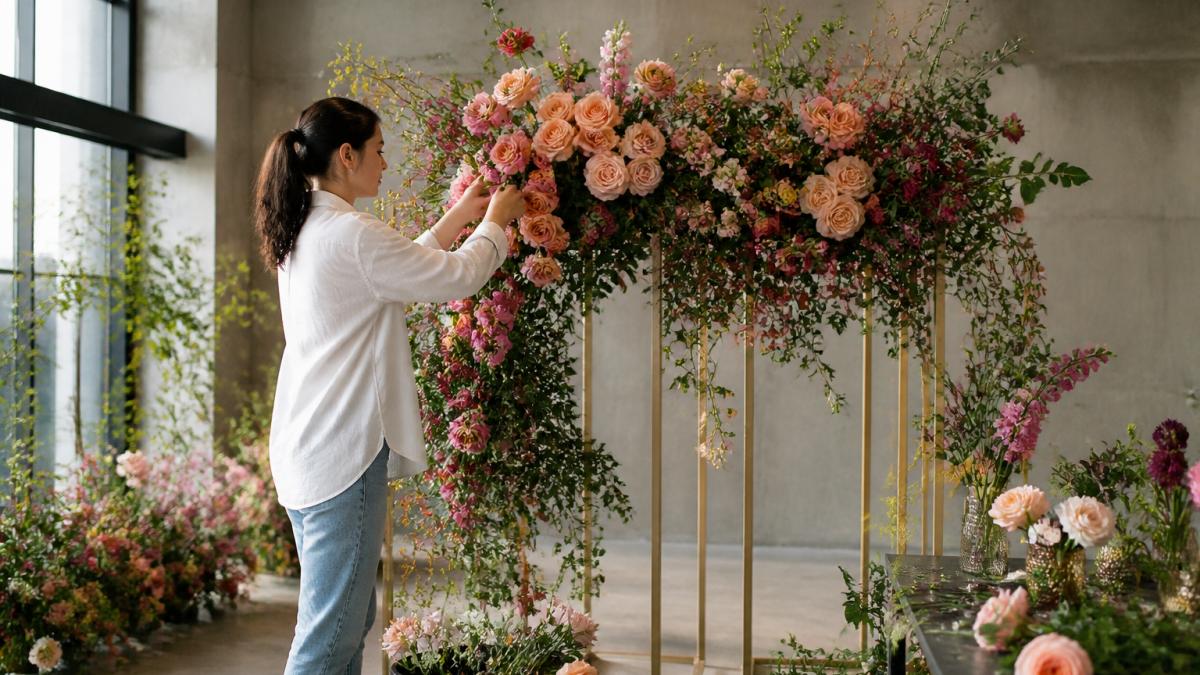
What Makes a Floral Design Couture
Couture is not a synonym for expensive. A modest installation with disciplined mechanics reads as couture; a lavish one with visible zip ties does not.
Hanging Floral Chandeliers and Ceiling Treatments
The execution is where events go wrong. Overhead installations carry real weight, and that weight has to travel through the room's structure, not through drywall or decorative trim.
Suspension Points and Weight Distribution
Floral density affects weight more than most people expect. Fresh greenery holds water, and saturated floral foam adds pounds quickly. Spreading the design across four or more suspension points, rather than concentrating it on two, keeps each anchor well within safe limits. For guidance on load ratings and rigging safety, review the OSHA rigging and sling safety standards.
Ceremony Backdrops, Floral Walls, and Oversized Wreaths
Floral walls suit large flat surfaces where the room needs a focal point. Oversized wreaths work well for ceremonies that want a frame around the couple without a full wall. Ceremony backdrops built on freestanding frames win when the venue forbids ceiling attachments entirely.
Building a Floral Wall That Holds Its Shape
Floral density should follow the sightline. The center of the wall sits closest to cameras, so it earns the heaviest bloom coverage. Edges can run lighter, which also reduces weight.
Essential Floral Installation Tools for Events
| Tool Category | Key Items | Primary Use | What to Watch |
|---|---|---|---|
| Attachment | 22-gauge bind wire, 6-inch zip ties, floral tape, Oasis clips, chenille stems | Securing stems to frames and grids | Zip ties lose holding strength in heat; wire does not |
| Structure | Chicken wire (1-inch mesh), foam cages, wooden grid panels, weighted bases, C-clamps | Building the load-bearing skeleton | Mesh gauge determines how much greenery a panel can hold |
| Cutting | Floral shears, wire cutters, stem strippers, utility knife | Clean cuts and fast on-site adjustments | Dull shears crush stems and shorten bloom life |
| Finishing | Sheet moss, ribbon, drape fabric, touch-up blooms, spray bottle | Hiding mechanics and softening edges | Moss hides wire but adds water weight |
Foam-Free and Reusable Mechanics
Most published tool lists assume floral foam as the default water source. Foam-free mechanics are the higher-value skill and the one most guides skip. Reusable metal frames, wire grids, and water tubes outlast single-use foam, and they make teardown faster because the structure comes apart in panels rather than in soaked blocks. Where foam is used, cages keep it contained and make removal straightforward. The US EPA guidance on composting explains what organic material qualifies for composting after teardown.
Large Scale Floral Design Techniques: Color Blocking and Monochrome Drama
Color blocking creates movement. A wall split into bands of white, blush, and deep burgundy reads as deliberate and modern. Monochrome drama does the opposite: an all-white or all-green installation gains impact through volume and texture rather than contrast.
Tapered Arrangements and Floral Density
This structure solves two problems at once: it looks natural, and it keeps the center of gravity near the mounting point, the combination that makes an ambitious suspended design safe to hang.
Safety, Structural Integrity, and Installation Stability
Installation stability is the practice of confirming that a design will hold its shape and position for the full duration of an event, including load, wind, and foot traffic. It is the least glamorous part of the work and the most important.
Load Math Before Design
Rigging hardware has published working load limits. Carabiners, slings, and shackles are rated by the manufacturer, and those ratings assume the hardware is loaded along its intended axis. Side-loading a carabiner or knotting a sling reduces capacity in ways that are easy to miss. For guidance on load ratings and rigging safety, review the OSHA rigging and sling safety standards.
Venue Documentation and Insurance
Outdoor installations add a second layer. Wind load, ground anchoring, and a documented takedown trigger matter more than indoor stability checks. For outdoor work, the National Weather Service guidance on wind advisories is worth checking in the final 48 hours. A design that is safe indoors can become a hazard on an open lawn.
The Pre-Event Stability Check
- Anchor verification. Every suspension point and base is confirmed against the structural plan and the venue's written sign-off.
- Hardware inspection. Carabiners, slings, and shackles are checked for wear and confirmed to be loaded along their intended axis.
- Load testing. Weight is applied gradually and observed before the event opens, with the heaviest panels tested first.
- Clearance review. No installation hangs low enough to obstruct walkways or sightlines, and nothing sits within reach of guests who might pull on it.
- Weather planning. Outdoor pieces are weighted for wind and have a documented takedown trigger tied to the forecast.
Sustainable Mechanics and Post-Event Floral Repurposing
On the mechanics side, reusable metal frames, zip ties, and wire outlast single-use foam. Where foam is used, cages keep it contained and make removal straightforward. Composting floral waste is a common practice; the US EPA guidance on composting explains what organic material qualifies.
Conclusion: Planning Your Couture Floral Installation
Couture & Decor Social Events LLC works alongside event teams to capture the evening itself through photo booth experiences and event rentals.
Frequently Asked Questions
What is the difference between a floral arrangement and a floral installation?
A floral arrangement is a self-contained piece, like a centerpiece or bouquet, that sits on a surface. A floral installation is a large-scale, built-in design that transforms a space, such as a hanging ceiling piece, a ceremony backdrop, or a full floral wall. Installations require structural planning, specialized tools, and often a team to assemble on site. If you are planning couture floral ideas for a wedding or corporate event, an installation delivers the immersive, photo-ready impact that a table arrangement cannot.
What are the current trends in large-scale floral installations?
Designers are moving toward color-blocked floral walls, monochrome drama using a single bloom variety, oversized wreaths, and suspended chandeliers with trailing greenery. Minimalist and modern floral art, which uses negative space and clean lines, is also growing. Alongside the visual trends, there is a push for sustainable mechanics like chicken wire and reusable structures instead of floral foam. These couture floral directions give hosts a striking focal point while keeping the design practical to build and strike.
How do professional designers structure hanging floral installations?
Hanging installations start with the ceiling, not the flowers. Designers identify rated rigging points, calculate the combined weight of the structure, water sources, and blooms, and build a lightweight frame from chicken wire or metal grid. Bind wire and zip ties attach the floral elements to the frame, and the whole piece is tested for balance before it goes up. Weight distribution and installation stability are checked at every stage, which is why hanging work is best handled by an experienced installation team.
What types of flowers are best for long-lasting event installations?
Roses, orchids, carnations, chrysanthemums, and sturdy greenery like ruscus and eucalyptus hold up well over a long event day. These varieties tolerate being out of water for hours and keep their shape in dense couture floral designs. For hanging pieces and floral walls, designers often mix fresh blooms with preserved or dried elements to extend life and reduce weight. Sourcing flowers that are in season locally also improves freshness and lowers cost, which matters for large-scale work.